Climate-Resilient Landscaping: Designing Gardens for the UAE of the Future
The UAE’s extreme summer heat and limited water resources make climate-resilient landscaping design increasingly important for villas, communities and commercial properties across Dubai, Abu Dhabi, Sharjah and beyond.
This article explains what climate-resilient design actually means, why it matters for UAE properties, and how you can apply it to your own garden or project.
1. What Does Climate-Resilient Landscaping Mean?
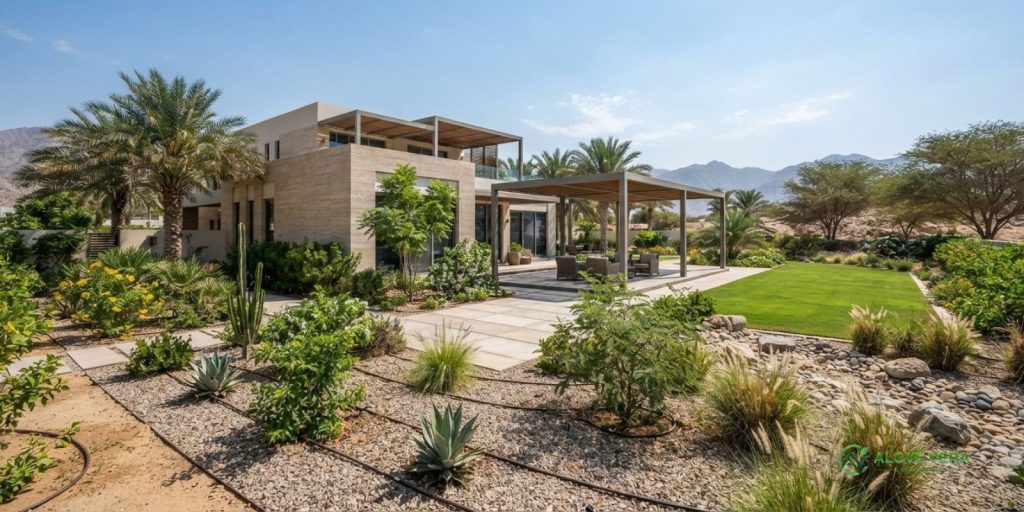
In simple terms, Climate-Resilient Landscaping means designing outdoor spaces that can handle extreme heat, limited rainfall, strong sun and occasional heavy storms without constant failure or replacement.
Instead of fighting the local climate with high-maintenance lawns and delicate imported plants, this approach works with the environment. Key principles include:
- Choosing plants suited to heat, wind and soil salinity
- Reducing water waste through smart irrigation
- Using materials that handle sun and temperature swings well
- Planning drainage for both drought periods and sudden rain
This is the foundation of what many designers now call climate-adapted landscaping UAE projects, whether for a small villa garden or a large public park.
2. Why the UAE Needs Climate-Resilient Gardens Now
The case for Climate-Resilient Landscaping is not just theoretical. The UAE experiences very high summer temperatures, with temperatures exceeding 40°C in many areas during the hottest periods (NCM, https://www.ncm.ae). At the same time, UAE government communication continues to stress sustainability and efficient resource use as national priorities, including water conservation (UAE Government Portal, https://u.ae).
For property owners, this combination creates real pressure:
- Traditional lawns and tropical planting often fail or need heavy irrigation.
- Water costs and availability concerns are pushing smarter design choices.
- Storms, though occasional, can cause drainage problems if not planned for.
Because of these factors, climate-resilient gardens UAE are shifting from a “nice idea” to a practical necessity for anyone planning long-term outdoor spaces.
3. Native Plants: The Backbone of Climate-Resilient Landscaping
Plant choice sits at the centre of any successful climate-resilient design. Many native UAE plants are naturally adapted to local heat, water limitations and challenging growing conditions, although their suitability still depends on the specific site and maintenance plan.
Common native species used in Climate-Resilient Landscaping include:
- Ghaf trees, valued for shade and deep root systems
- Sidr trees, both functional and culturally significant
- Native shrubs and grasses that require minimal irrigation once established
Benefits of prioritising native species:
- Lower long-term water requirements
- Better resistance to leaf burn and heat stress
- Reduced plant replacement costs over several years
- Support for local birds and pollinators
Where native options are limited, well-proven adapted species (plants from other arid regions that have performed reliably in the UAE) can fill gaps while still supporting a resilient design.
4. Smart Water Management in Climate-Resilient Gardens
Water efficiency is arguably the most important technical element of Climate-Resilient Landscaping. Without it, even the right plants can struggle or waste resources unnecessarily.
Practical water strategies include:
- Drip irrigation instead of open sprinklers for planting beds and trees
- Zoned irrigation systems, so lawns, shrubs and pots receive different watering schedules
- Smart controllers that adjust based on season and weather
- Soil improvement and mulching to retain moisture longer between waterings
For larger developments, some projects also explore treated wastewater use where permitted, supporting broader sustainable landscaping UAE goals at a community level.
For villa owners, simply switching from manual hoses to a properly zoned drip system can improve water control and help reduce unnecessary irrigation during peak summer months.
5. Hardscape Choices That Support Climate-Resilient Design
Climate-Resilient Landscaping is not only about plants. The hard surfaces in your garden—paving, walls, and structures—also need to handle UAE conditions well.
Key considerations:
- Light-toned paving can absorb less heat than some darker finishes, depending on the material and exposure.
- Permeable surfaces, where appropriate, help manage sudden rainfall instead of creating runoff problems.
- Durable materials like quality stone or porcelain resist UV damage and temperature-related cracking better than cheaper alternatives.
- Shade structures, such as pergolas or gazebos, reduce direct heat exposure on both people and surfaces.
These choices work together with planting decisions to create outdoor spaces that remain comfortable and functional throughout the year, not just during cooler months.
6. Drainage: Preparing for Both Drought and Sudden Rain
One aspect people often overlook in Climate-Resilient Landscaping is drainage. The UAE experiences long dry periods punctuated by occasional intense rainfall, and gardens need to handle both extremes.
Good drainage design includes:
- Correct grading so water moves away from villa foundations
- Channel drains or soakaways in low-lying areas
- Avoiding hardscape designs that trap water against walls or structures
Without this planning, even a well-chosen plant palette can suffer from waterlogging during rare but heavy storms, undermining the resilience the rest of the design was meant to provide.
7. Applying climate-resilient garden design to Villa Gardens
For private homeowners, adopting Climate-Resilient Landscaping does not mean giving up on beauty or comfort. It means making smarter choices within your existing vision.
A practical approach might include:
- Replacing large lawn areas with a mix of native trees, shrubs and smaller, functional grass patches
- Positioning shade trees to protect both outdoor seating and parts of the villa façade
- Installing drip irrigation with separate zones for different plant types
- Choosing durable, light-coloured paving for terraces and pathways
This combination supports genuine future-ready landscaping UAE homeowners can rely on, rather than a garden that requires repeated repairs, replacement planting or irrigation adjustments every summer.
8. Climate-adapted landscaping for Commercial and Public Spaces
Offices, hotels, hospitals and public parks face similar pressures on a larger scale. For these properties, Climate-Resilient Landscaping offers practical business and operational benefits:
- Lower long-term maintenance and replacement costs
- More consistent appearance across large areas
- Better alignment with sustainability expectations often highlighted in UAE government and municipal communications (UAE Government Portal, https://u.ae)
For facility managers, working with a landscaping partner who understands both plant performance and water-efficient design can significantly reduce the ongoing cycle of failed planting and repeated replacement.
9. Getting Started With Climate-Smart Landscaping
If you are planning a new project or renovating an existing landscape, consider these steps:
- Assess your current garden and identify plants or areas that consistently struggle.
- Group plants by water needs to simplify irrigation zoning.
- Prioritise native and proven adapted species for the majority of your planting.
- Choose hardscape materials that handle heat and occasional heavy rain well.
- Plan drainage early, not as an afterthought once construction is underway.
This structured approach helps ensure your garden performs well for years, rather than needing major rework after just one or two harsh summers.
10. How Much Does Climate-Resilient Landscaping Cost in the UAE?
The cost of climate-resilient landscaping in the UAE depends on garden size, plant selection, irrigation requirements, drainage, hardscape materials and the complexity of the project. A small planting upgrade may require a modest budget, while a complete villa landscape with new irrigation, shade structures, drainage and hardscape can cost considerably more.
| Project type | Indicative UAE cost |
|---|---|
| Small planting refresh | AED 3,000–10,000 |
| Native/adapted planting upgrade | AED 5,000–20,000 |
| Villa garden improvement | AED 15,000–50,000 |
| Irrigation upgrade | AED 5,000–25,000+ |
| Drainage improvements | AED 5,000–20,000+ |
| Complete climate-resilient villa landscape | AED 30,000–100,000+ |
| Larger commercial landscaping | AED 100,000+ |
These are general planning ranges, not fixed quotations. Actual costs depend on site access, existing conditions, plant maturity, soil preparation, irrigation, drainage, hardscape, electrical work and custom features. A site assessment is recommended before confirming a project budget.
11. How AV Landscaping Supports Future-Ready Garden Design
AV Landscaping works with residential, commercial and institutional clients across the UAE, helping them design and build landscapes that hold up to local conditions. This includes:
- Landscape design incorporating Climate-Resilient Landscaping principles from the start
- Selection of native and adapted plants suited to specific sites
- Irrigation system design focused on water efficiency
- Hardscape construction using durable, climate-appropriate materials
- Ongoing maintenance to support long-term garden health
If your current garden struggles every summer, or you are planning a new outdoor space in Dubai, Abu Dhabi, Sharjah or elsewhere in the UAE, you can discuss your site and goals with AV Landscaping at https://avlandscaping.ae. Working with a team that understands Climate-Resilient Landscaping can help you build a garden that stays functional, attractive and manageable well into the future.
FAQs
1. What is climate-resilient landscaping?
It is landscape design that uses plants, materials, irrigation and drainage suited to local climate conditions.
2. Is climate-resilient landscaping suitable for UAE villas?
Yes, it can be adapted to villas of different sizes, styles and maintenance requirements.
3. Does climate-resilient landscaping save water?
Efficient plants, irrigation zoning and smart watering can help reduce unnecessary water use.