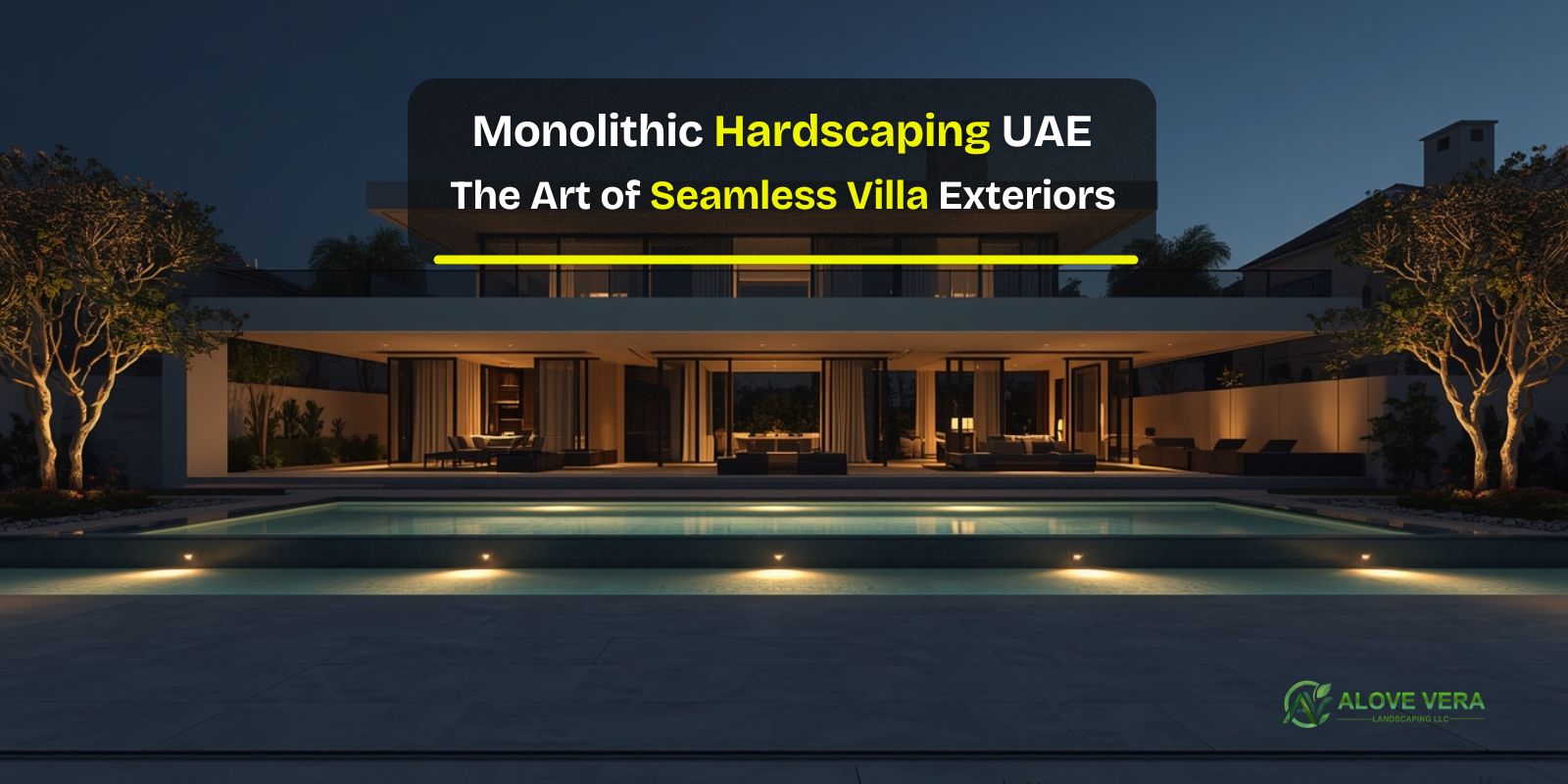
Monolithic Hardscaping UAE: The Art of Seamless Villa Exteriors
In today’s UAE villa design, cluttered patterns and busy, multi‑coloured pavers are rapidly being replaced by calm, continuous surfaces. This new direction is defined by Monolithic Hardscaping – large, seamless ground planes that feel sculpted rather than assembled.
At AV Landscaping, we use Monolithic Hardscaping to create exteriors that look clean, expansive, and architecturally precise. Instead of your eye getting lost in joints and patterns, it reads the villa and landscape as one strong, unified composition.
What Is Monolithic Hardscaping?
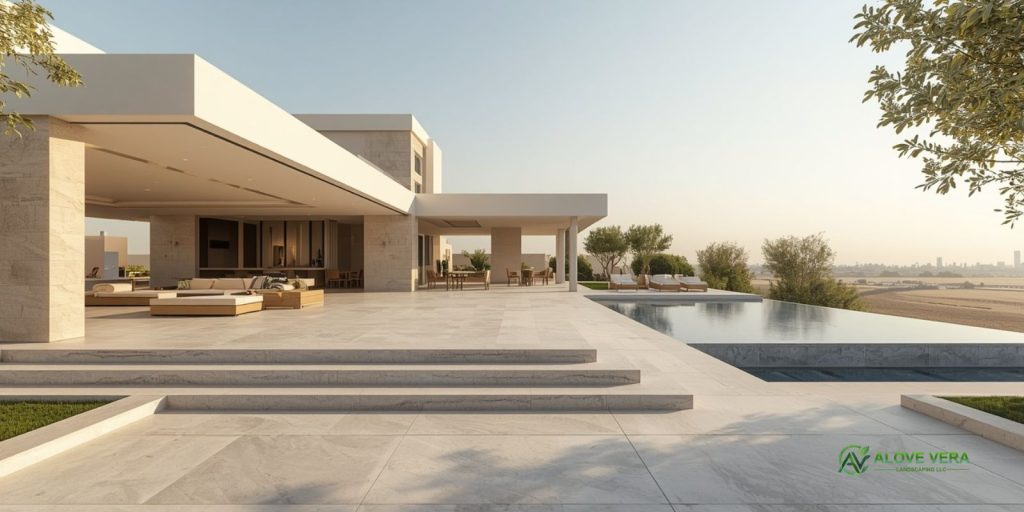
This minimalist approach is a design approach that favours scale and simplicity. Rather than building outdoor surfaces from hundreds of small pavers and grout lines, we work with:
- Large‑format porcelain or stone slabs
- Poured‑in‑place concrete with a single, refined texture
- Custom‑cut, high‑performance stone or concrete panels
The effect is a terrace, path, or deck that appears to be carved from one continuous surface. This approach makes:
- Small spaces feel larger and more open
- Large estates feel calm, grounded, and connected
- Modern villas look more intentional and premium
Monolithic Hardscaping is minimalism done with engineering discipline, not just with style choices.
Why Monolithic Hardscaping Works So Well in the UAE
The UAE environment, architecture, and lifestyle make this hardscape strategy a natural fit.
Reduced Visual Noise in Harsh Light
Under intense desert sunlight, busy patterns and multi‑tone pavements can feel chaotic and tiring. With Monolithic Hardscaping:
- The number of visible joints is dramatically reduced
- Colour and texture are controlled and consistent
- The ground acts as a calm backdrop for architecture, planting, and water
This “visual reset” is especially powerful in villas with strong façades and sculptural planting. The surfaces stop competing with the design and start supporting it.
Better Thermal Performance and Comfort
With this landscape approach, we can select materials and colours that perform better in the UAE heat:
- Light‑toned stone, porcelain, or concrete with high solar reflectance
- Finishes that don’t store and radiate as much heat as dark, dense materials
- Fewer joints where weeds, dirt, and heat can accumulate
The result is more comfortable terraces and walkways during shoulder seasons, better long‑term appearance, and less maintenance headache as the garden ages in a challenging climate described across national platforms like https://u.ae.
Seamless Architectural Flow
Contemporary UAE villas often feature:
- Large glass façades
- Floating staircases and cantilevered roofs
- Strong horizontal lines and minimal detailing
This outdoor design method lets the outside answer this architecture directly:
- Interior flooring can visually extend to exterior terraces with minimal interruption
- Thresholds feel smooth and continuous rather than broken by pattern changes
- The villa and landscape read as one connected design rather than two separate layers
This is especially impactful around pool decks, living room terraces, and main entrances, where first impressions are formed in seconds.
Core Elements of a Monolithic Hardscaping Strategy
Designing the hardscape system is not just about choosing big tiles. It’s about aligning structure, detail, and experience.
Surface Types and Material Choices
We often combine or select from:
- Large‑format porcelain slabs for terraces and pool decks
- Poured‑in‑place concrete with refined, consistent finishes
- Natural stone panels like limestone or travertine in large modules
Each material is evaluated for:
- Heat behaviour and comfort underfoot
- Slip resistance when wet (especially near pools)
- Colour stability and resistance to UV and salt
- Maintenance requirements and expected lifespan
This architectural hardscape style demands that every slab or pour is “right”, because the minimal language leaves nowhere for technical or aesthetic mistakes to hide.
Integrated Levels and Transitions
With large, continuous surfaces, the detailing of steps, edges, and slopes becomes critical:
- Gentle, planned gradients for drainage rather than random falls
- Crisp, aligned step nosings and risers
- Clean terminations against planting beds, pool edges, and boundary walls
Because this hardscape strategy reduces visual breaks, these transitions become the main linework in the garden. They must be intentional and precise.
The Engineering Behind Monolithic Hardscaping
The calm simplicity on the surface is built on very careful engineering beneath.
Sub‑Base Design and Stability
Large slabs and monolithic pours need a stable, reinforced base:
- Engineered sub‑base with correct compaction and layering
- Reinforced concrete base, where necessary, to control movement
- Proper isolation from tree roots and other shifting elements
Without this, large‑format hardscape can crack or settle unevenly. At AV Landscaping (https://avlandscaping.ae), we treat the hardscape system as a structural element, not just a finish.
Expansion and Movement Joints
In the UAE, temperature swings, materials expand and contract. this landscape approach must accommodate this intelligently:
- Expansion joints carefully positioned and sized
- Joint lines aligned with design axes so they feel like part of the pattern
- Use of suitable sealants or joint profiles for durability and appearance
The aim is to make necessary joints feel deliberate – read as part of the geometry – rather than as random breaks.
Safety and Tactile Quality
Minimal does not mean slippery or harsh. For Monolithic Hardscaping we:
- Choose finishes with sufficient slip resistance, especially around water
- Consider barefoot comfort for pool and lounge areas
- Balance honed, brushed, or textured surfaces to achieve both safety and elegance
This landscape approach should feel solid and reassuring, not hard and unforgiving.
Design Benefits of this outdoor design method for Your Villa
Beyond engineering, the minimalist ground plane approach offers strong visual and lifestyle benefits.
- Stronger focus on architecture
- The villa’s lines, openings, and cantilevers take centre stage
- Outdoor furniture, sculptures, and planting are highlighted cleanly
- Perception of space
- Fewer visual breaks make terraces feel larger
- Long, continuous runs draw the eye and create a sense of scale
- Timeless aesthetic
- Neutral, monolithic grounds age more gracefully than trendy patterns
- Updates to furniture or planting can happen without changing the hardscape
In a market where simplicity and quality signal luxury, Monolithic Hardscaping quietly communicates both.
The AV Landscaping Approach to Monolithic Hardscaping
Implementing the seamless surface concept in the UAE requires a team that understands both design intent and local conditions.
At AV Landscaping:
- We start from your villa’s architecture and interior finishes to define proportions and materials
- We model levels and drainage to support true monolithic planes without water issues
- We coordinate structure, utilities, and finishing so that no last‑minute services disturb the clean layout
- We test slip resistance, heat behaviour, and maintenance implications before final selection
Every project becomes a tailored response: a driveway that feels like a single plane of stone, a pool deck that appears to float from interior flooring, or a courtyard that feels carved from one calm surface.
If you want your villa exterior to reflect a “less but better” philosophy, Monolithic Hardscaping is one of the most powerful tools available. To explore how this approach can transform your UAE property, visit https://avlandscaping.ae and connect with the AV Landscaping team.
FAQs
1. What is Monolithic Hardscaping?
Monolithic Hardscaping is a landscape design approach that uses large, seamless surfaces such as oversized porcelain slabs, natural stone panels, or poured concrete to create a clean and minimalist outdoor environment.
2. Is Monolithic Hardscaping suitable for UAE villas?
Yes. Monolithic Hardscaping is ideal for UAE villas because it reduces visual clutter, complements contemporary architecture, and can be designed using heat-resistant materials suitable for the desert climate.
3. Which materials are commonly used in Monolithic Hardscaping?
Large-format porcelain slabs, poured-in-place concrete, travertine, limestone, and engineered stone panels are among the most popular materials used in Monolithic Hardscaping projects.